News
Bike hangars have become one of the most recognisable forms of secure cycle parking across the UK, and in the right setting, they play a valuable role.

In high-density urban areas, particularly where residents live in flats, terraces or shared accommodation with limited private storage, bike hangars provide a practical residential parking solution. They help local authorities create secure on-street cycle storage in areas where people may not have access to a garage, shed or private garden.
However, when it comes to destination cycle parking, a different approach is often required.
Residential Parking and Destination Parking Are Not the Same
A successful cycle parking strategy should begin with one simple question: where is the cyclist going to use it?
Residential cycle parking is designed for people storing their bike close to home, usually overnight or for long periods of time. Bike hangars are well suited to this type of use, especially in dense residential streets where private storage is limited.
Destination cycle parking is different. This is the parking people need when they cycle to a workplace, hospital, college, university, town centre, transport interchange, leisure centre or community facility. In these locations, users are often leaving their bike for several hours during the day and need confidence that it will still be there when they return.
For destination parking, the priorities are different:
- secure, individual access
- convenient location close to the entrance
- weather protection
- easy day-to-day use
- suitability for commuter, visitor and staff use
- reduced risk of theft, damage or misuse
- flexibility for councils, employers and site operators
This is why cycle hubs and individual cycle lockers are often a more suitable solution for destination cycle parking than standard residential bike hangars.
.jpg "Cycle Hub")
The Right Product for the Right Location
Bike hangars are not a one-size-fits-all solution.
In large urban centres such as London, Glasgow, Manchester or other densely populated residential areas, bike hangar schemes can make excellent sense. They provide secure parking where home storage is limited and where demand for on-street residential cycle storage is high.
But in many towns, boroughs and suburban areas, the challenge can be very different. Many residents may already have access to a shed, garage, garden or other form of private storage at home. In these areas, the bigger opportunity may not be residential cycle parking, but destination cycle parking.
That means supporting people at the point where they are most likely to question whether cycling is practical:
“Where will I securely leave my bike when I get there?”
If the answer is unclear, cycling becomes less attractive. Even where cycle routes are improved, a lack of secure parking at the destination can still discourage people from making everyday journeys by bike.
Secure Destination Parking Can Help Change Travel Behaviour
For local authorities, schools, healthcare sites, universities, rail stations, business parks and town centres, secure destination cycle parking can make cycling a more realistic option.
A person may be willing to cycle to work, to a hospital appointment, to the shops or to a public transport connection — but only if they know their bike can be left in a safe and secure location.
This is particularly important as more people invest in higher-value bicycles, including e-bikes, cargo bikes and adapted cycles. These bikes can be life-changing for commuting and everyday travel, but they also require higher-quality storage. A basic stand may not provide enough reassurance, especially for long-stay parking.
By focusing on destination parking, councils and organisations can help remove one of the most common barriers to cycling: the fear of theft or damage.
Why Cycle Lockers Make Sense for Destination Parking
Individual cycle lockers provide a high level of security and convenience for users. They are particularly effective where cyclists need to leave their bike for several hours, such as at workplaces, hospitals, schools, colleges, transport hubs and public facilities.
Unlike open stands, cycle lockers provide an enclosed space for each bicycle. This helps protect the bike from the weather and reduces exposure to theft, vandalism and accidental damage.
They are also easy to manage. Lockers can be allocated to individual users, staff, visitors or members depending on the needs of the site. For many locations, this makes them a practical alternative to a wider residential hangar scheme.
The FalcoLok Cycle Locker
The FalcoLok cycle locker has been designed to provide secure individual cycle parking in a compact and flexible format.
Each FalcoLok unit provides secure parking for five bikes, with five individual doors and separate internal compartments. This gives each user their own dedicated space, helping to improve security and ease of use.
The FalcoLok is manufactured from durable hot-dip galvanised steel and can be powder coated in a wide choice of RAL colours to suit the surrounding environment or match local authority branding. It can also be supplied with a green sedum roof, helping to support sustainable development plans while enhancing the visual appearance of the installation.
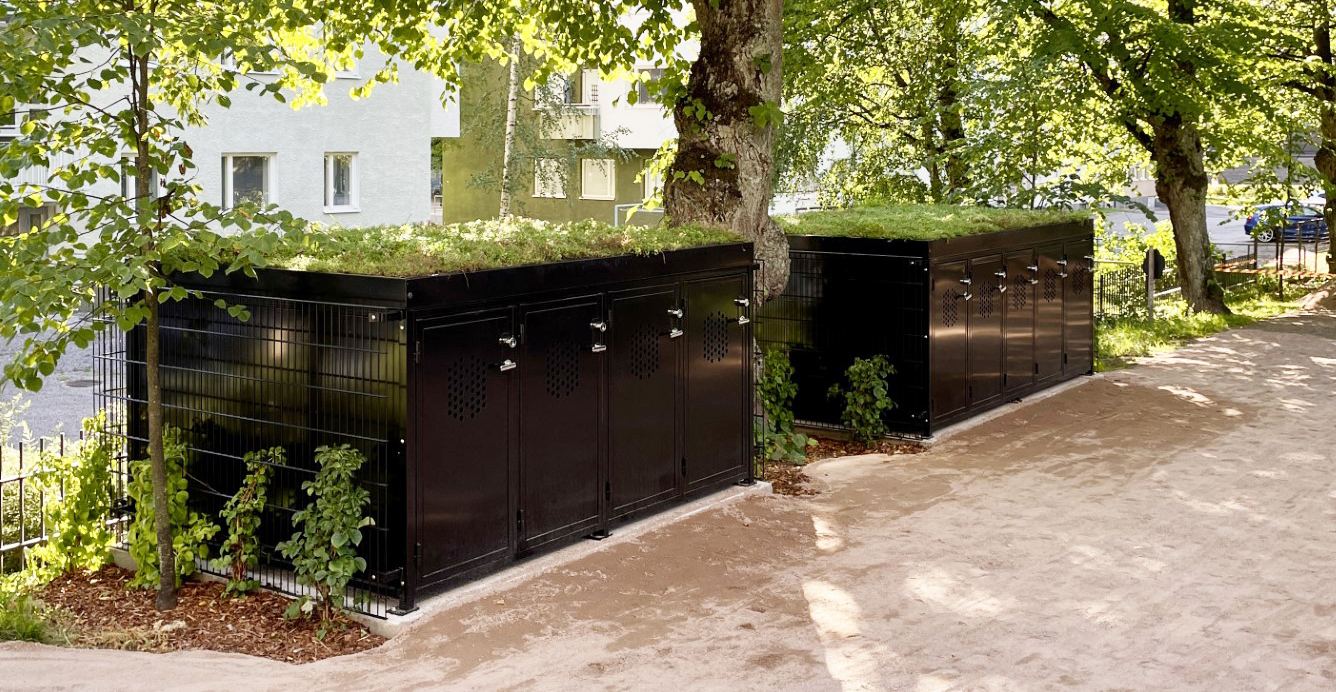
For larger schemes, the FalcoLok cycle locker can be extended in multiples of five spaces, making it suitable for small, medium or larger destination parking projects.
Typical applications include:
- town centres
- workplaces
- hospitals and healthcare sites
- transport interchanges
- colleges and universities
- schools
- leisure centres
- business parks
- community facilities
- residential developments requiring allocated secure spaces
Funding Does Not Have to Mean Bike Hangars Only
As local authorities continue to invest in active travel infrastructure, it is important that cycle parking funding is used in the most effective way for each location.
In some areas, the priority may be residential bike hangars. In others, the greater need may be secure destination parking that supports everyday cycling journeys to work, education, healthcare, leisure and public transport.
A successful cycle parking strategy should not start with a product. It should start with the journey.
Where are people cycling from?
Where are they cycling to?
How long will the bike be left there?
What level of security is required?
Who will manage access?
What type of cycles need to be accommodated?
By asking these questions, councils and organisations can deliver infrastructure that genuinely supports behaviour change and helps more people choose cycling for everyday journeys.
Supporting Better Cycle Parking Choices
Falco provides a wide range of secure cycle parking solutions, including bike hangars, cycle lockers, cycle hubs, cycle shelters, two-tier cycle racks, Sheffield stands, cargo bike parking and e-bike charging infrastructure.
This means we can support clients in selecting the most appropriate solution for their site, rather than applying a single product to every location.
Bike hangars have an important role to play in residential cycle parking, particularly in dense urban areas. But for destination cycle parking, cycle hubs and secure cycle lockers such as the FalcoLok often provide a more practical and targeted solution.
The aim should always be the same: to make cycling easier, safer and more convenient.
For advice on planning a destination cycle parking scheme, or to discuss how the FalcoLok cycle locker could support your next project, contact the Falco sales team on 01538 380080 or email sales@falco.co.uk.


Falco has been a family company with its own production site for over 70 years. Sustainability was in our DNA from the very beginning and this is reflected within our complete range of modular cycle parking and shelter products, all designed with full circularity in mind.
All products ranges are contemporary and durable, typical of a Falco product. Falco has been at the forefront of the cycle parking and street furniture market and has built up a renowned reputation for manufacturing products that exceed in both design and durability.
Falco’s operations have supported the Circular Economy for many years, simply manufacturing products with environmentally friendly products, that can last for decades and at the end of the product life can be 100% recycled and manufactured back into a brand new product.


